
QUASI-GOVERNEMENTAL ORGANIZATIONS (QGOs) INVOLVED IN NUCLEAR ACTIVITIES IN WYOMING
(Scroll to INFO below to see, What is a quasi-governmental organization?)
OUT OF STATE QGOs (We are only mentioning the ones we find relevant to this website)
| Their Info | Our Info |
| Council of State Governments (CSG) | Council of State Governments (CSG) |
WYOMING STATE QGOs (We are only mentioning the ones we find relevant to this website)
| Their Info | Our Info |
| WY Energy Authority | WY Energy Authority |
| WY Business Council | WY Business Council |
WYOMING LOCAL QGOs (We are only mentioning the ones we find relevant to this website)

WHAT IS A QUASI-GOVERNMENTAL ORGANIZATION?
As dry as this subject may sound, it is essential knowledge that a citizen should learn because it provides insight into how some funding comes in at the state and local levels through and to entities that are not accountable to citizens.
Most people are familiar with the term NGO, meaning “non-government organization”. The Salvation Army, Habitat for Humanity, or Green Peace are examples of NGOs. NGOs typically offer some sort of service, but they are not part of, or run by the government. Most NGOs are also non-profit organizations, which places them in a special tax bracket.
Few people are familiar with the term QGO, meaning “quasi-governmental organization”.
quasi = used to show that something is almost, but not completely, the thing described
Many QGOs operate in the areas of economic development, community development, or health and human services.
QGOs often appear to be a governmental entity because:
- They are recognized and promoted by elected government officials
- typically occur on government websites
- They receive taxpayer money from official government bodies (state and/or federal) – usually in the form of a grant
- typically listed in government annual budgets
- They usually have a small percentage of members that are, in fact, elected officials
- They award or recommend funds (taxpayer money) to businesses or individuals
QGOs generally do not:
- have public meetings
- publish meetings minutes or vote records
- account for how they have spent funds they received
- publish financial documents (monthly expenditures, budgets or audits)
QGOs are created to side-step constitutional duties and restrictions that an official government entity would be held accountable for by their constituents. The Wyoming Energy Authority (WEA) is a perfect example:
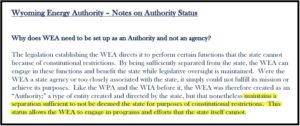
Wyoming Joint Minerals Committee, May 16-17, 2029, Meeting Material # 2-01
https://wyoleg.gov/InterimCommittee/2019/09-201905162-03WEA-AuthoritySummary.pdf
You now might ask yourself, How did our legislature get away with creating an unconstitutional organization? Easy: Barely anyone noticed or cared – including 76 legislators who passed the bill (SF0037, 2019) that created the WEA, and most of Wyoming citizens who just weren’t paying attention.
The Wyoming Business Council (WBC) is another Quasi-Governmental organization. They are organized differently than the WEA, but are equally, and egregiously, unconstitutional. Both receive significant amounts of money within our biennial State of Wyoming Budget (and sometimes within supplemental budgets in off years). Because the WEA and WBC receive such large amounts of funds, they attempt to be somewhat transparent. According to LSO, the WBC is subject to the Wyoming Public Records Act and the Public Meetings Act. At the end of the day however, a citizen has very little say on the decisions made by these Wyoming State QGOs.
Both the WBC and WEA are heavily involved in all Governor Gordon’s energy plans for Wyoming, with nuclear being the new sacred cow.
Local QGO’s in Wyoming have scant transparency and accountability for their activities. To find out what money they receive, one must search through county or city/town financial documents, usually budgets or supplemental budgets. Local QGO examples in Wyoming include all of the local economic development boards, whether it is a county or city entity. For example, the Energy Capital Economic Development organization for Campbell County. Perusing their website, one will find they have:
- 20 board seats with only 2 elected government officials; most members are business related
- No public meeting announcements
- No meeting minutes
- No financial information whatsoever
Note: The Campbell County government website recognizes and promotes the Energy Capital Economic Development organization, and they do provide meeting information. Whether any local citizens would be allowed to influence or comment at any of these meetings remains to be seen.
« Previous Article | Next Article »