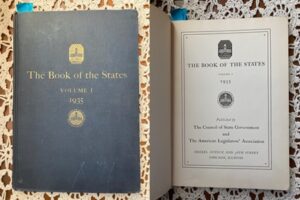
The Council of State Governments (CSG) was established in 1935 in Chicago, Illinois. Along with the American Legislator’s Association (established around 1928), the CSG published Volume I of The Book of the States. The CSG has been publishing an annual version of this book every year since 1935:
The CSG is a quasi-governmental organization that has been regionalizing the actions, duties and power of elected offices, in all states, and in all three branches of state government.
Regionalization is antithetical to federalism, and to the Tenth Amendment of the U.S. Constitution.
One way to visualize the difference between federalism and regionalism: Under federalism our nation is like a rich and diverse quilt of many (50) colors, patterns and textile; under regionalism the fabric gradually becomes uniform in color and shape, and continuous in the same cloth.
When organizations such as CSG or NCSL (National Conference of State Legislatures) bring the same elected officials together from several states (such as state legislators or state treasurers) to change policy or vote on specific regional issues, those elected officials expand their reach and power beyond state and district borders where they were elected, and far beyond the local people who elected them.
The WY State Legislature has an ongoing annual membership for both CSG and NCSL. As of 2024 WY Legislative Budget, annual dues for NCSL is $269,500.00, and annual dues for CSG is $229,022.00. That’s approximately half a million dollars every year.
On occasion some states do have justifiable reasons to come together for specific issues that effect each party/state within a region – such as rivers and tributaries that feed many states, and the various interstate water compacts that have been agreed upon in the past.
Regionalism can get out of hand quickly however, where representatives or (even worse) unelected officials, from several states act together as a unit toward a goal or agenda without the constituents from their state or district being aware of that goal or agenda at all. The obvious push for nuclear energy in Wyoming has gained noticeable momentum in this same way the last five years and is building faster and stronger.
In the following you will find there are at least three unelected individuals selected via executive appointment by WY Governor Gordon. Each of these individuals has been given voting power to move and change significant nuclear related policy both within and outside the state of Wyoming. Even worse, these unelected individuals are not just voting on nuclear issues beyond Wyoming borders, they are also voting on issues beyond the borders of the United States of America.
Because there is nothing at the Governor’s website or the WY Legislative website that hones in on these compact related commissions it is almost certain that most WY citizens and WY legislators are completely unaware that they exist at all – much less what they are carrying out.
Interstate Compacts
Under the CSG umbrella is the self-appointed overseer of Interstate Compacts, called the National Center for Interstate Compacts (NCIC). NCIC has a list of 41 Wyoming Interstate Compacts. From this list there are two that are nuclear related:
- Northwest Interstate Compact on Low-Level Radioactive Waste Management (See WY §9-6-206 to 210).
Dec 2025 Update: the compact document that CSG links to is a Northeast Compact – not the Northwest Compact. - Western Interstate Nuclear Compact (See WY §9-6-101 to 105)
Northwest Interstate Compact on Low-Level Radioactive Waste Management (NWIC)
Joined in 1992, Wyoming is one of eight party states within this compact, which includes: Alaska; Hawaii; Idaho; Montana; Oregon; Utah; Washington; and Wyoming.
According to the National Center for Interstate Compacts:
The party states recognize that low-level radioactive wastes are generated by essential activities and services that benefit the citizens of the states. It is further recognized that the protection of the health and safety of the citizens of the party states and the most economical management of low-level radioactive wastes can be accomplished through cooperation of the states in minimizing the amount of handling and transportation required to dispose of such wastes and through the cooperation of the states in providing facilities that serve the region. It is the policy of the party states to undertake the necessary cooperation to protect the health and safety of the citizens of the party states and to provide for the most economical management of low-level radioactive wastes on a continuing basis. It is the purpose of this compact to provide the means for such a cooperative effort among the party states so that the protection of the citizens of the states and the maintenance of the viability of the states’ economies will be enhanced while sharing the responsibilities of radioactive low-level waste management.
According to WY § 9-6-207 Appointment of compact committee member:
The governor shall appoint one (1) member and an alternate to serve as the Wyoming representative on the committee for the Northwest Interstate Compact on Low-Level Waste Management [§ 9-6-206]. The member and alternate shall serve at the pleasure of the governor and shall receive no compensation, but shall be reimbursed for expenses in the same manner and amount as a state employee to be paid from funds available from the governor’s office or from the compact.
According to their website the representative appointed by WY Governor Gordon to the NWIC is Brandi O’Brien who is the Uranium Recovery Program Manager within the Wyoming Department of Environmental Quality. The NWIC does not note who the WY alternate might be.
According to the Feb 2025 Report on Waste Burial Charges Changes in Decommissioning Waste Disposal Costs at Low-Level Waste Burial Facilities Final Report published by the Nuclear Regulatory Commission (NRC):
Page iii: The currently operating low-level waste (LLW) disposal facilities that are licensed by the NRC or Agreement States are located in 1) Texas, 2) South Carolina, 3) Washington, and 4) Utah.
Page 9: The Richland, Washington facility only accepts LLW from the Northwest and Rocky Mountain Compacts. The Northwest Compact is comprised of the States of Idaho, Montana, Oregon, Utah, Washington, Wyoming, Alaska, and Hawaii. The Rocky Mountain Compact is comprised of the States of Colorado, Nevada, and New Mexico.
Dec 20, 2025 Update:
On December 19, 2025 members of the Northwest Interstate Compact on Low-Level Radioactive Waste Management approved a proposal from EnergySolutions to import 1.3 million cubic yards from Ontario, Canada power plants to its facility in Clive, Utah – roughly 60 miles west of Salt Lake City. Read more here.
Western Interstate Nuclear Compact (WINC)
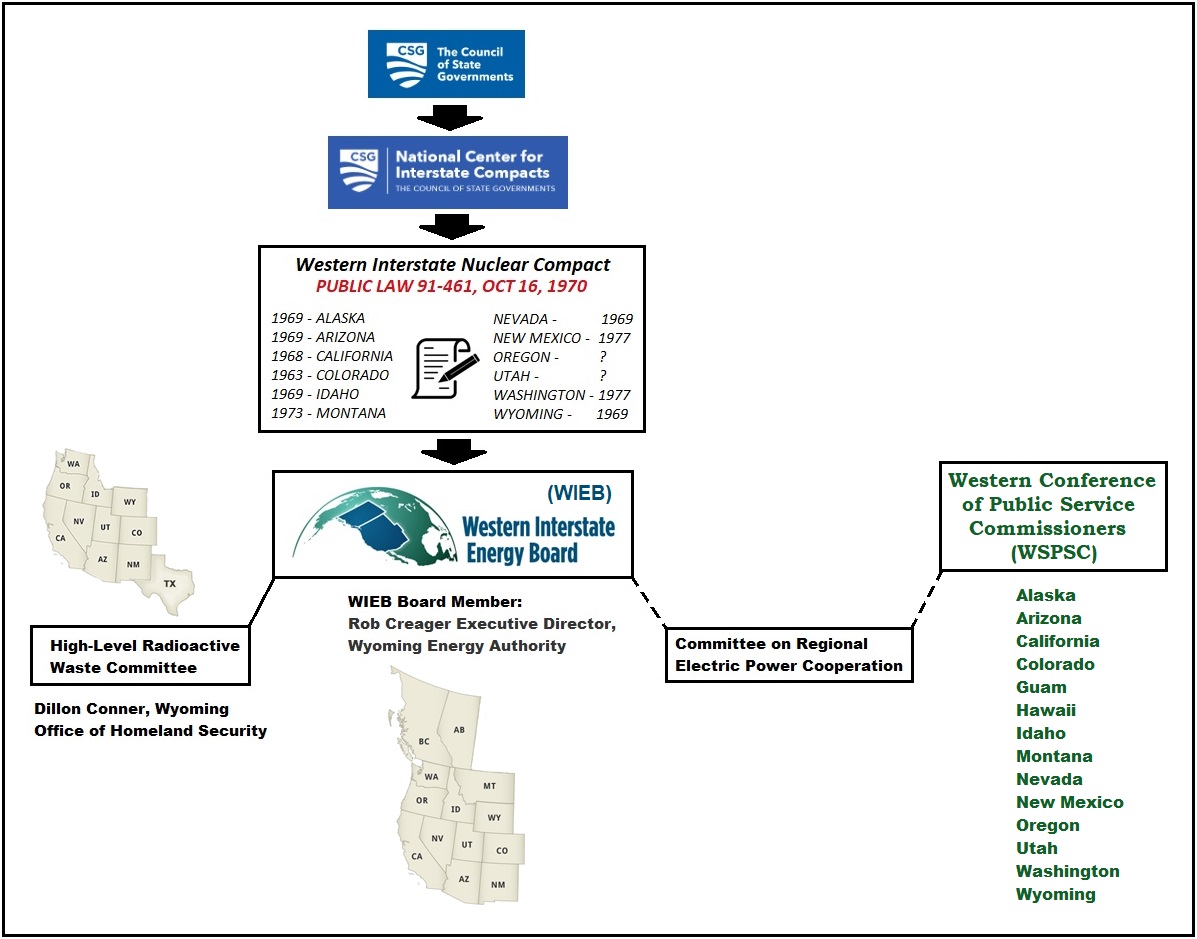
This compact is not nearly as straightforward as the Northwest Interstate Compact on Low-Level Radioactive Waste Management, and the regionalism embedded in this compact twists at various turns and even extends beyond the borders of our country into Canada. (Images below illustrate some of these dynamics.)
Wyoming joined the Western Interstate Nuclear Compact in 1969. The following year PUBLIC LAW 91-461 (Oct 16, 1970) was passed by Congress, “to encourage and recognize the performance of functions by the States with respect to the peaceful use of nuclear energy in its several forms“.
By 1977, twelve states became party to the Western Interstate Nuclear Compact. They are: Alaska; Arizona; California; Colorado; Idaho; Montana; Nevada; New Mexico; Oregon; Utah; Washington; and Wyoming.
The CSG National Center for Interstate Compacts describes the Western Interstate Nuclear Compact as:
The party states recognize that the proper employment of scientific and technological discoveries and advances in nuclear and related fields and direct and collateral application and adaptation of processes and techniques developed in connection therewith, properly correlated with the other resources of the region, can assist substantially in the industrial progress of the west and the further development of the economy of the region. They also recognize that optimum benefit from nuclear and related scientific or technological resources, facilities and skills requires systematic encouragement, guidance, assistance, and promotion from the party states on a cooperative basis. It is the policy of the party states to undertake such cooperation on a continuing basis. It is the purpose of this compact to provide the instruments and framework for such a cooperative effort in nuclear and related fields, to enhance the economy of the west and contribute to the individual and community well-being of the region’s people.
The CSG National Center for Interstate Compacts identifies the Western Interstate Energy Board as the “National Organization” for the Western Interstate Nuclear Compact.
Western Interstate Energy Board
At an unknown date the Western Interstate Energy Board (WIEB) was formed. According to CSG, this board does not acknowledge Alaska as a party state from the Western Interstate Nuclear Compact, but then adds Canadian Provinces British Columbia and Alberta as Compact entities with voting power. CSG claims that Public Law 91-461 is the legal basis for this board, and “the purpose of the Board is to provide the instruments and framework for cooperative state efforts to enhance the economy of the West and contribute to the well-being of the region’s people.” The Board seeks to achieve this purpose by promoting energy policy that is developed cooperatively among member states and provinces and with the federal government“.
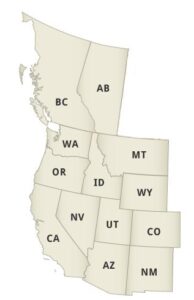
The governor of each state, and the premier of each province appoints a member to the Board.
According to their website WY Governor Gordon appointed Rob Creager, the Executive Director of the newly created Wyoming Energy Authority (WEA) as the WY Representative to the Western Interstate Energy Board.
Rob Creager is an unelected official in charge of the quasi-governmental WEA – which was created in 2019 as an entity that “maintains a separation sufficient to not be deemed the state for purposes of constitutional restrictions. This status allows the WEA to engage in programs and efforts that the state itself cannot.”
Thus a newly created quasi-governmental entity formed in Wyoming has been given voting power with a quasi-governmental regional entity, which includes Canadian Provinces, to drive energy policy and push WY taxpayer funds to enhance the economy of the West and contribute to the well-being of the region’s people.
The work of the WIEB Board is conducted through two committees:
- The High Level Radioactive Waste Committee (HLRWC)
- Committee on Regional Electric Power Cooperation (CREPC)
High Level Radioactive Waste Committee (HLRWC)
According to CSG/NCIC : The High-Level Radioactive Waste Committee is composed of representatives from eleven Western states who have expertise in the realm of spent nuclear fuel and high-level radioactive waste transportation. Since the 1980s, the HLRW Committee has engaged with this topic, offering comments, analyzing proposals, developing policies, and interacting with federal, industry, tribal, and other state regional groups. The HLRW Committee performs some of this work under a Cooperative Agreement with the U.S. DOE Office of Nuclear Energy.
These states include Arizona; California; Colorado; Idaho; Montana; Nevada; New Mexico; Oregon; TEXAS; Utah; Washington; and Wyoming.
According to their website WY Governor Gordon appointed Dillon Conner of the Wyoming Office of Homeland Security to the HLRWC.
Committee on Regional Electric Power Cooperation (CREPC)
Regarding the CREPC, according to CSG/NCIC: The Committee on Regional Electric Power Cooperation (CREPC) was established in 1982. CREPC is a joint committee of the Western Interstate Energy Board (WIEB) and the Western Conference of Public Service Commissioners (WCPSC). In November 2022, WIEB and WCPSC adopted a Charter articulating the scope, role, and membership of the Committee.
(Members of the Western Conference of Public Service Commissioners (WCPSC) include: Alaska; Arizona; California; Colorado; GUAM; Hawaii; Idaho; Montana; Nevada; New Mexico; Oregon; Utah; Washington; and Wyoming.)
CREPC is composed of an energy office official and a regulatory utility commissioner from each of the Western states and Canadian provinces and focuses on electric power system policy issues that require regional cooperation in the West. All state and provincial agency personnel, not just designated CREPC Members, are invited and encouraged, to participate in meetings and discussions.
 We realize that is a lot of information to digest, and we will try to untangle this better in the coming days.
Zooming out, here is one last thought for every Wyoming citizen:
Is there anything anywhere at the WY Legislative website or the Governor’s website that notifies WY citizens on any of the above entities, agreements, or plans for our future in our state?
« Previous Article | Next Article »