

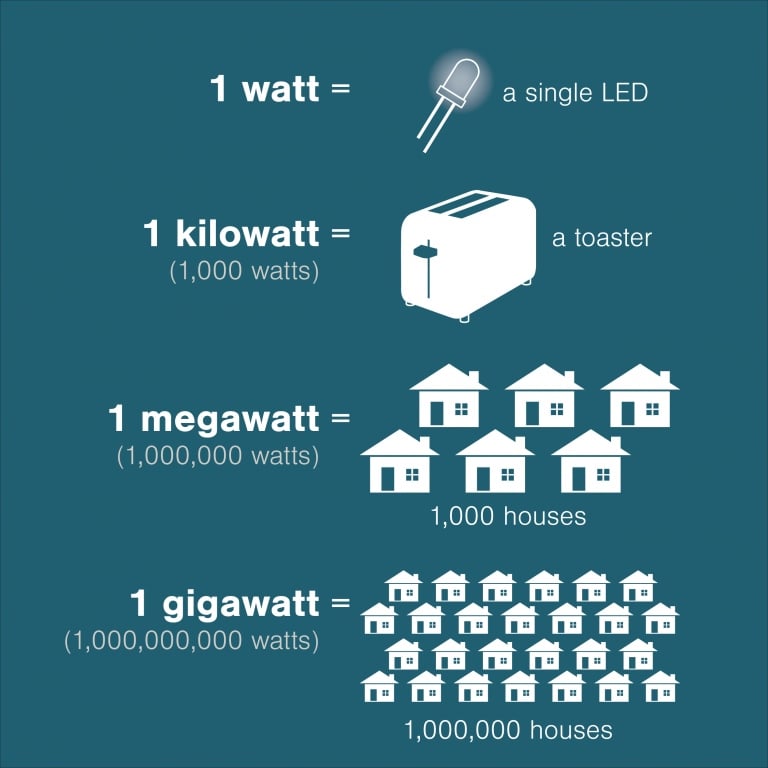
A Megawatt (MW) is a unit of power, meaning how fast energy is being produced or used at a moment in time – think of it like speed.
A Megawatt-hour (MWh) is a unit of energy, meaning how much energy is produced or consumed over time. Think of it like a distance traveled.
For example, a 5 MW source running for 1 hour produces 5 MWh, and ran for 4 hours would be equivalent to 20 MWh.
Said another way, Energy (MWh) = Power (MW) × Time (hours)
Electricity bill context
Your utility bill charges you for “energy”, not power, thus, MWh.
Power plants capacity or demand is measured in Megawatts (MW)
A factory drawing 2 MW while operating that’s how fast it’s using electricity.
Megawatt-hours (MWh) is what consumers pay for “total energy used over time”
For example, that same factory uses 2 MW for 10 hours equates to 20 MWh consumed.
Nuclear reactors are usually rated in “MW electric (MWe)” (that’s the electricity delivered to the grid). A typical modern reactor capacity is around 1,000 – 1,600 MW (1 – 1.6 GW), A 1,200 MW reactor can continuously supply power at that level when running normally. You could say that’s the “engine size”. How much they deliver, Megawatt-hours (MWh), this is the “total energy produced over time”.
Nuclear plants run almost constantly (90–95% capacity factor, so their MWh output over a year is huge. For instance, a 1,200 MW reactor running at 92% capacity for a year: 1,200 (MW) × 8,760 (hours) × 0.92 ≈ 9.7 (million MWh), that’s 9.7 terawatt-hours (TWh) per year.
| Source | Power Rating Needed | Rough Scale |
| Comparison for the same annual energy (~10 TWh/year) | ||
| Nuclear | ~1.2 GW | 1 reactor |
| Coal | ~1.8 – 2 GW | Multiple units |
| Wind | ~3 t 4 GW | ~ 1,000 large turbines |
| Solar | ~ 5 – 6 GW | 4 square miles |
Power vs energy in nuclear operations
Why MW matters: grid stability, reactor thermal limits, turbine size.
Why MWh matters: annual generation, revenue, fuel burn up planning.
Nuclear plants are designed to sit near their MW rating all the time, which is why their MWh output is so large relative to nameplate size. A nuclear plant’s MW rating tells you how much it can push at any moment. Its MWh output tells you how relentlessly it does so.
Large nuclear reactors (the classics)
Typical size: 1,000 – 1,600 MW(e) per unit, thermal power ~3× higher (reactor heat to electricity)
Energy delivery: capacity factor: 90–95%, annual output (1.2 GW unit) – stated another way, about 9–10 TWh/year.
What they’re good at: massive, steady base load, lowest cost per MWh “once built”, and very long lifetimes (60–80 years).
Tradeoffs: huge upfront capital cost, long construction timelines, grid needs to be able to absorb a 1+ GW unit.
Small Modular Reactors (SMRs)
Typical size: 50 – 300 MW(e) per module (many designs cluster around ~77 MW to ~300 MW)
Energy delivery: same physics and similar capacity factor (85–95%).
Annual output per 300 MW module: ~2.3 TWh/year. But here’s the trick, you stack them. For instance, 4 × 300 MW modules = 1.2 GW, same annual energy as a big reactor if fully built out.
| Direct Comparison | ||
| Feature | Large Reactor | SMR |
| Power per unit | 1–1.6 GW | 50–300 MW |
| Annual energy per unit | 8–12 TWh | 0.4–2.5 TWh |
| Capacity factor | 0–95% | 85–95% |
| Construction | One huge build | Factory + site assembly |
| Grid impact | Big single step | Gradual, modular |
| Capital risk | Very high | Lower per module |
Stated in another way, MW vs MWh intuition, large reactor (Big MW all at once, huge MWh immediately); SMRs (smaller MW steps, MWh ramps up as modules are added). Both same destination, different path.
Where SMRs shine
- Smaller or weaker grids
- Replacing coal plants (reuse turbines, grid hookups)
- Remote or industrial sites
- Countries that can’t swallow a 1+ GW project risk
Where big reactors still win
- Dense, stable grids
- Maximum energy per site
- Lowest lifetime cost per MWh
- Proven operating experience
Large reactors are power monsters; SMRs are power Legos.
Same physics, same energy density — just different scaling strategy.
Here’s a breakdown of 1 trillion Watts (1 trillion Watts, AKA, 1 Terawatt) in various units:
So, 1 trillion Watts is equivalent to:
1,000 Gigawatts (GW)
1,000,000 Megawatts (MW)
1,000,000,000 Kilowatts (kW)
1,000,000,000,000 Watts (W)
|