Western Interstate Nuclear Compact (WINC)
Correlates to WY §9-6-101 to 105
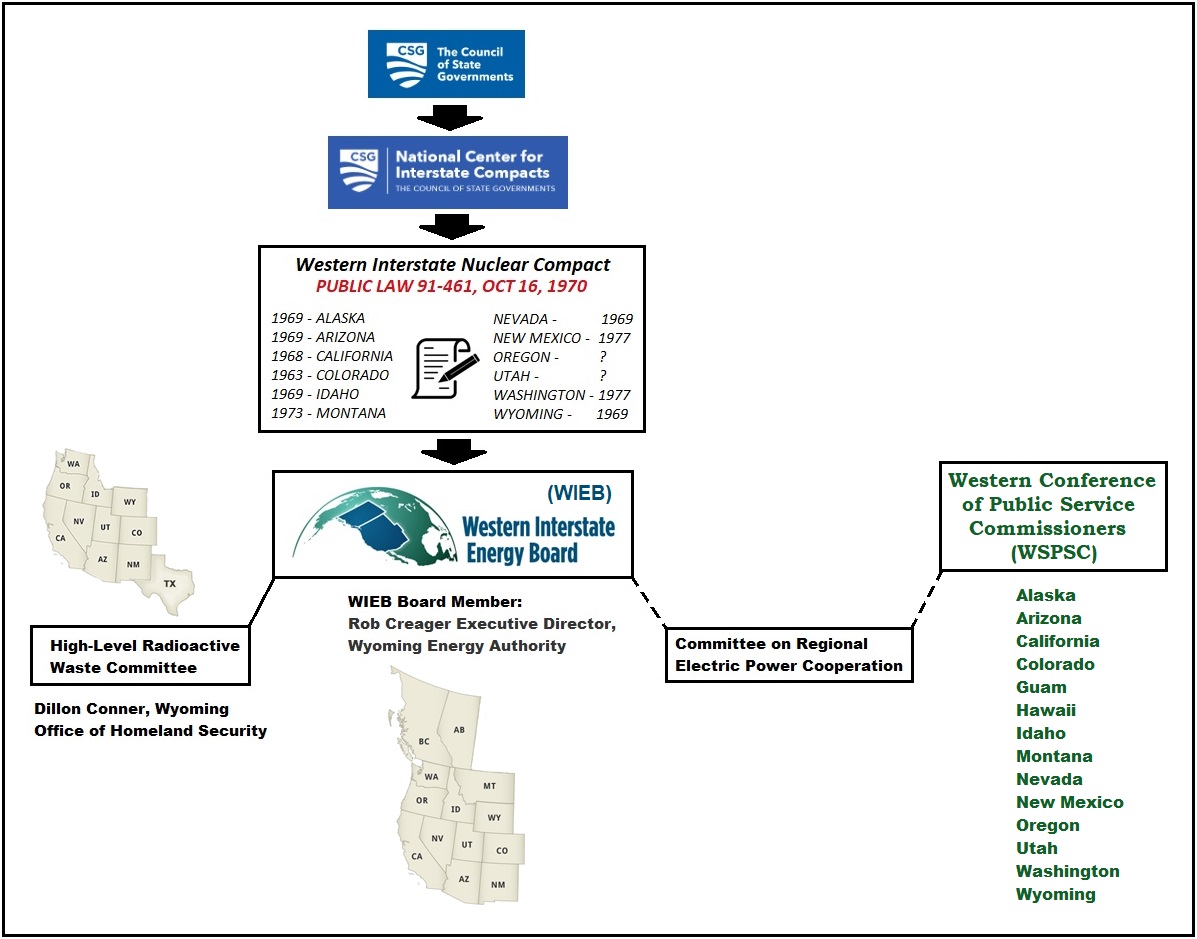
The regionalism embedded in this compact twists at various turns and even extends beyond the borders of our country into Canada. (Images below illustrate some of these dynamics.)
Wyoming joined the Western Interstate Nuclear Compact in 1969. The following year PUBLIC LAW 91-461 (Oct 16, 1970) was passed by Congress, “to encourage and recognize the performance of functions by the States with respect to the peaceful use of nuclear energy in its several forms“.
By 1977, twelve states became party to the Western Interstate Nuclear Compact. They are: Alaska; Arizona; California; Colorado; Idaho; Montana; Nevada; New Mexico; Oregon; Utah; Washington; and Wyoming.
The CSG National Center for Interstate Compacts describes the Western Interstate Nuclear Compact as:
The party states recognize that the proper employment of scientific and technological discoveries and advances in nuclear and related fields and direct and collateral application and adaptation of processes and techniques developed in connection therewith, properly correlated with the other resources of the region, can assist substantially in the industrial progress of the west and the further development of the economy of the region. They also recognize that optimum benefit from nuclear and related scientific or technological resources, facilities and skills requires systematic encouragement, guidance, assistance, and promotion from the party states on a cooperative basis. It is the policy of the party states to undertake such cooperation on a continuing basis. It is the purpose of this compact to provide the instruments and framework for such a cooperative effort in nuclear and related fields, to enhance the economy of the west and contribute to the individual and community well-being of the region’s people.
The CSG National Center for Interstate Compacts identifies the Western Interstate Energy Board as the “National Organization” for the Western Interstate Nuclear Compact.
Western Interstate Energy Board
At an unknown date the Western Interstate Energy Board (WIEB) was formed. According to CSG, this board does not acknowledge Alaska as a party state from the Western Interstate Nuclear Compact, but then adds Canadian Provinces British Columbia and Alberta as Compact entities with voting power. CSG claims that Public Law 91-461 is the legal basis for this board, and “the purpose of the Board is to provide the instruments and framework for cooperative state efforts to enhance the economy of the West and contribute to the well-being of the region’s people.” The Board seeks to achieve this purpose by promoting energy policy that is developed cooperatively among member states and provinces and with the federal government“.
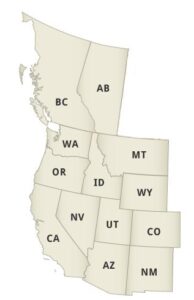
The governor of each state, and the premier of each province appoints a member to the Board.
According to their website WY Governor Gordon appointed Rob Creager, the Executive Director of the newly created Wyoming Energy Authority (WEA) as the WY Representative to the Western Interstate Energy Board.
Rob Creager is an unelected official in charge of the quasi-governmental WEA – which was created in 2019 as an entity that “maintains a separation sufficient to not be deemed the state for purposes of constitutional restrictions. This status allows the WEA to engage in programs and efforts that the state itself cannot.”
Thus a newly created quasi-governmental entity formed in Wyoming has been given voting power with a quasi-governmental regional entity, which includes Canadian Provinces, to drive energy policy and push WY taxpayer funds to enhance the economy of the West and contribute to the well-being of the region’s people.
The work of the WIEB Board is conducted through two committees:
- The High Level Radioactive Waste Committee (HLRWC)
- Committee on Regional Electric Power Cooperation (CREPC)
High Level Radioactive Waste Committee (HLRWC)
According to CSG/NCIC : The High-Level Radioactive Waste Committee is composed of representatives from eleven Western states who have expertise in the realm of spent nuclear fuel and high-level radioactive waste transportation. Since the 1980s, the HLRW Committee has engaged with this topic, offering comments, analyzing proposals, developing policies, and interacting with federal, industry, tribal, and other state regional groups. The HLRW Committee performs some of this work under a Cooperative Agreement with the U.S. DOE Office of Nuclear Energy.
These states include Arizona; California; Colorado; Idaho; Montana; Nevada; New Mexico; Oregon; TEXAS; Utah; Washington; and Wyoming.
According to their website WY Governor Gordon appointed Dillon Conner of the Wyoming Office of Homeland Security to the HLRWC.
Committee on Regional Electric Power Cooperation (CREPC)
Regarding the CREPC, according to CSG/NCIC: The Committee on Regional Electric Power Cooperation (CREPC) was established in 1982. CREPC is a joint committee of the Western Interstate Energy Board (WIEB) and the Western Conference of Public Service Commissioners (WCPSC). In November 2022, WIEB and WCPSC adopted a Charter articulating the scope, role, and membership of the Committee.
(Members of the Western Conference of Public Service Commissioners (WCPSC) include: Alaska; Arizona; California; Colorado; GUAM; Hawaii; Idaho; Montana; Nevada; New Mexico; Oregon; Utah; Washington; and Wyoming.)
CREPC is composed of an energy office official and a regulatory utility commissioner from each of the Western states and Canadian provinces and focuses on electric power system policy issues that require regional cooperation in the West. All state and provincial agency personnel, not just designated CREPC Members, are invited and encouraged, to participate in meetings and discussions.
There is nothing at the WY Legislative website or the Governor’s website that notifies WY citizens on any of the above entities, agreements, or plans for our future in our state.
« Previous Article |